
Material Guide
PC vs PC/ABS: Selecting a Polycarbonate-Based Compound
Compare polycarbonate and PC/ABS at a practical level, including impact, heat, appearance, processability and the role of grade-specific formulation.
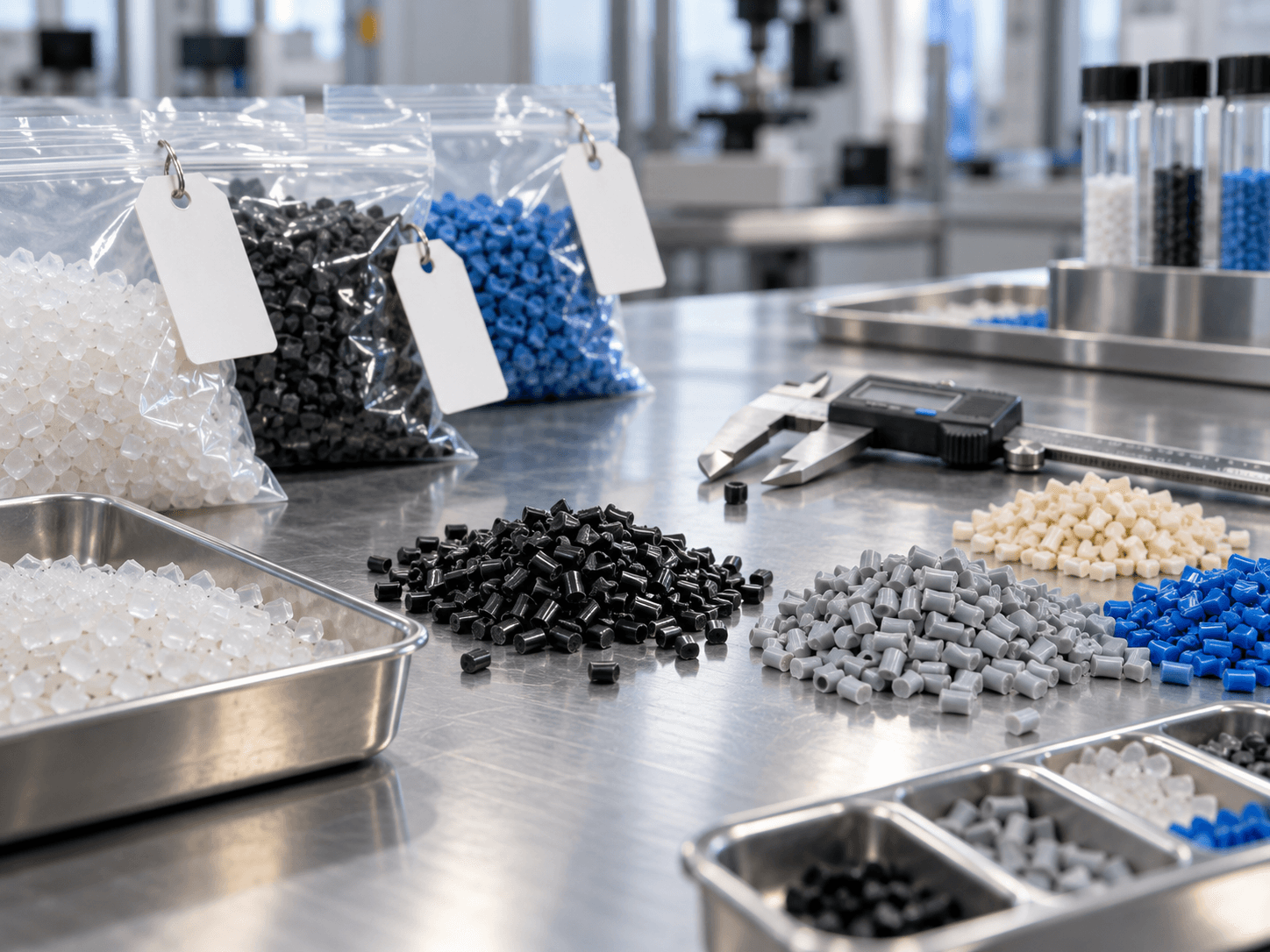
PC and PC/ABS are a trade-space, not a simple hierarchy. PC is often chosen for a combination of impact and heat capability; PC/ABS grades can offer a different balance of flow, surface appearance and low-temperature impact. The grade and test condition decide the practical result.
Decision context
The right starting point is a concise application brief: identify the finished article, its use environment, the conversion route, the current material if known, and the requirement that would make a candidate unacceptable. This keeps the discussion grounded in a decision rather than a category label.
What changes the answer
Chemical contact, internal stress, wall thickness, texture and cosmetic acceptance should be specified before sampling. A housing that sees cleaning agents or repeated assembly loads has different evidence needs from an interior trim component.
Engineering and processing implications
Polycarbonate-based materials require attention to preparation and moisture management. Process feasibility should include dry material handling, melt residence time, gate and venting behavior, surface appearance and any downstream plating, printing or assembly.
Design trade-offs to make visible
PC/ABS is often evaluated where molding flow and surface result are part of the commercial problem, while PC may remain attractive when the required balance favors its base performance profile. Neither description establishes suitability for cleaners, internal stress, UV exposure or a flame-rated design.
Surface and assembly
Texture, gloss, paint, printing, ultrasonic welding and snap features should appear in the sample brief. A grade that fills a plaque cleanly may reveal stress whitening, weld-line visibility or cosmetic variation on a textured enclosure.
Trial and release plan
Define the comparison before samples arrive. Identify the relevant test method, specimen or finished part, condition, process settings, acceptance criterion and owner of the decision. Record lot identity and deviations. For an existing material, preserve a baseline; for a new formulation, include process capability, visual quality and downstream assembly or converting where relevant.
Questions that prevent false equivalence
- Which requirement is mandatory at release, and at what test condition?
- What does the incumbent process reveal about drying, flow, warpage, surface or scrap risk?
- Which grade-specific documents or declarations are required?
- What finished-part test would expose the consequence of a wrong choice?
- Who approves a material or process change after evidence is complete?
Related decisions
Continue with injection molding material selection and material substitution framework. For an application-specific shortlist, use Explore Materials or Discuss a Material Requirement.
Evidence chain
For pc vs pc abs, organize the review around service condition, material state, part geometry and the process window. Separate what is known from a technical source, what must be confirmed for the candidate grade, and what only a representative application trial can show. This structure keeps commercial urgency from turning a preliminary screen into an unsupported conclusion.
Start with a source that describes the relevant material family or processing mechanism, then use grade-specific supplier documents for the proposed candidate. Keep the evidence chain visible: family guidance explains why a question matters; the exact commercial grade and finished-part test decide whether it is acceptable. This distinction prevents a technical article from becoming a pseudo-datasheet.
Use a short decision record after the trial: requirement, candidate identity, conditions, observed result, unresolved risk and next action. It gives purchasing, engineering, quality and operations a shared basis for moving forward or declining a candidate. It also helps a distributor connect the processor's real need with a materially appropriate compound or masterbatch without claiming manufacturer, laboratory or consulting capability.
Implementation note
For pc vs pc abs, do not treat a first satisfactory sample as the end of the decision. Confirm that the result is repeatable at the intended operating conditions and that the documentation follows the material through approval. If a critical requirement changes, reopen the review rather than assuming the original result transfers unchanged.
Decision record
A practical pc vs pc abs review records the candidate identifier, source documents, material condition, process settings, test method, result, exception and release owner. This small record is valuable when results must be compared across lots, facilities or later revisions. It also separates an application observation from a broad claim about a polymer family.
When the evidence is incomplete, describe the open question plainly. That is preferable to filling the gap with an assumed compatibility, approval or performance statement. The next trial can then be designed to resolve a specific uncertainty.
Technical boundary
This guide is category-level education, not a grade specification. Polymer behavior varies by commercial grade, formulation, reinforcement, additives, conditioning, processing history, test method, geometry and end use. Confirm the proposed supplier grade and validate the representative application.