
Insight
When should a plastics processor qualify a second source for a polymer compound?
A practical framework for deciding when an alternate compound deserves qualification, what evidence is needed, and how to keep a backup source ready.

When should a plastics processor qualify a second source for a polymer compound?
A practical framework for deciding when an alternate compound deserves qualification, what evidence is needed, and how to keep a backup source ready.
A compound can be inexpensive, consistent and easy to process, yet still leave a plant exposed if only one approved source can supply it. The decision to qualify an alternative is therefore broader than a purchasing comparison: it is a decision about how much interruption the business can absorb, and how long it takes to establish a usable replacement.
Begin qualification when the time needed to approve and obtain an alternative threatens to exceed the coverage available from usable inventory and credible recovery plans. That is a planning rule, not a universal numerical threshold. A critical part with demanding approvals can justify early qualification even when the incumbent supplier performs well.
First define what “second source” means
A second distributor selling the same compound may provide another inventory position or delivery route. It does not necessarily provide another manufacturing source. Two compounders may also depend on the same base-resin producer, specialized additive, tolling facility or transport bottleneck.
There are three materially different alternatives:
- Another channel for the identical grade: potentially useful for stock availability, subject to approved provenance, traceability and commercial terms.
- Another production site for the incumbent grade: potentially useful for site disruption, but site qualification and common upstream dependencies still matter.
- A different manufacturer's compound: potentially greater supply independence, with a broader material and part qualification burden.
State the disruption you want to cover before choosing the alternative. A second warehouse will not resolve the loss of the only plant making the compound. A different compounder will not necessarily resolve a shortage of an essential additive shared by both formulations.
Use lead time as an early-warning test
Estimate the elapsed time from deciding to pursue an alternative to receiving approved production material. Include sample procurement, document review, trial scheduling, testing and conditioning, customer decisions, repeat trials, and the first commercial shipment. Activities can overlap; map the critical path instead of simply adding every task duration.
Then compare that estimate with coverage for the affected application. Count released, usable material at realistic consumption rates. Exclude quarantined stock, unsuitable colors or grades, and deliveries that cannot be relied on. Assess whether demand growth or a slower-than-normal replenishment cycle will consume the buffer.
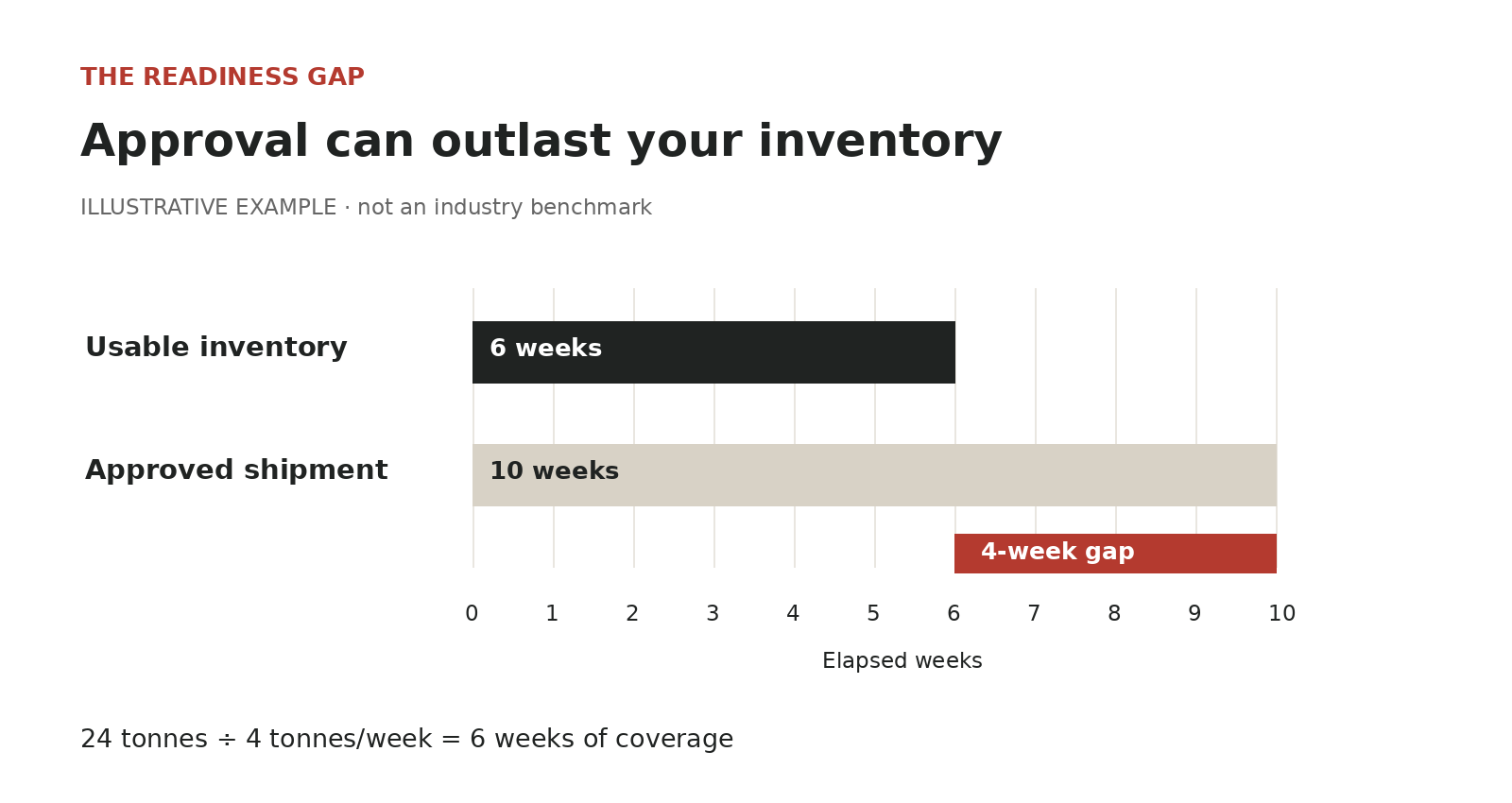
Illustrative example: a plant has 24 tonnes of usable compound and consumes 4 tonnes per week, giving six weeks of coverage. Its alternative-source plan requires ten weeks to complete approvals and receive the first usable shipment. If incumbent supply stops today, that plan leaves a four-week gap. This is arithmetic about a hypothetical plant, not an industry benchmark.
The response may require both an immediate coverage measure and a qualification project. Additional incumbent stock, production resequencing or an approved alternate part design may bridge a gap; none automatically establishes an independent material source.
Illustrative planning example: 24 tonnes at 4 tonnes per week covers six weeks; a ten-week approval-and-delivery path leaves four weeks uncovered.
Five situations that justify opening a qualification project
1. A shortage would stop a commercially important product
Prioritize compounds used in parts that constrain shipments, have little substitution flexibility or carry substantial customer consequences. Annual compound spend alone can mislead: a small-volume material can prevent shipment of a much higher-value assembly.
Ask what production can continue without the material, whether lost output can be recovered, and whether customers would accept a revised delivery schedule. Estimate disruption exposure from unrecoverable contribution, incremental recovery costs and applicable contractual consequences. Avoid counting both lost revenue and lost contribution for the same units.
2. Supply performance is consuming the operating buffer
Repeated delivery slippage, allocation, unplanned changes in order quantities, weak recovery communication or an announced discontinuation can make an alternative worth pursuing. Use actual order history: requested versus confirmed dates, confirmed versus received dates, partial deliveries and premium freight.
A single late shipment need not trigger full qualification. A pattern that forces the plant to increase inventory or repeatedly change its schedule deserves a quantified review. Ask the incumbent for the cause and corrective plan while assessing alternatives.
3. Demand or product life is changing
A demand increase can turn an acceptable supply arrangement into a capacity constraint. A long remaining product life can justify spending on an approved alternative; a product nearing retirement may favor a final-buy plan instead. Consider new launches early enough to include source flexibility in specifications and customer discussions.
4. Commercial conditions no longer fit the operation
Higher landed cost, excessive minimum orders or an inflexible production schedule can justify a commercial qualification project. However, the alternative must earn its place at the plant. A lower quoted price can be offset by higher scrap, slower cycles, different part weight, added drying, freight or inventory.
Separate two objectives: reducing dependence and improving manufacturing economics. One candidate may achieve both, but a cheaper compound that shares the same vulnerable upstream input may contribute little resilience.
5. A known change creates an approval window
A tooling project, planned shutdown, specification revision or customer program review may make trials easier to schedule. Conversely, an incumbent's manufacturing-site or formulation change may require its own review. Treat these events as opportunities to examine the approved-source strategy rather than assuming every change requires the same test program.
A similar data sheet is a screening result
“PA66 with 30% glass fiber” is a useful starting description, not a complete material specification. Resin characteristics, reinforcement, stabilizers, impact modifiers, lubricants and color systems can differ. Define the application requirements before asking for a match.
Compare property values on a common basis: test standard, specimen geometry, conditioning, temperature, loading rate and units. Distinguish typical data-sheet values from contractual acceptance limits. Obtain the candidate's grade-specific processing guidance and documented quality controls.
For melt flow, ISO 1133-1:2022 specifies temperature and load conditions and notes that these measurements may not correlate with processing behavior because test shear rates differ from normal processing. Matching a melt-flow number therefore cannot establish equivalent filling or extrusion behavior.
Moisture deserves particular attention for relevant materials. BASF's Ultramid technical brochure describes dry-processing requirements and moisture-related dimensional effects for its polyamide grades. The practical implication is to control drying and compare parts at the specified conditioning state. Use the actual manufacturer's grade guidance rather than transferring a drying recipe from another material.
Qualify the part, the process and the supply arrangement
The processor's engineering and quality teams should define acceptance criteria before trials, with the customer and relevant approval bodies where required. Procurement should define supply requirements alongside them. The following stages are an editorial planning framework, not a replacement for an applicable customer procedure.
- Document screening: confirm grade identity, manufacturer and production site, specifications, traceability, processing guidance, required declarations and approval constraints. Stop early if a non-negotiable requirement cannot be met.
- Controlled plant trial: record drying, handling, machine and tool settings, material lot and test conditions. Establish an appropriate candidate process window; do not require identical settings simply to claim interchangeability.
- Part and assembly validation: assess dimensions, warpage, appearance, joining and actual service functions. Include aging, chemical exposure, creep, fatigue or electrical tests only where the application requires them. Define sample size and statistical acceptance from risk and customer requirements.
- Production repeatability: establish evidence appropriate to the risk across production conditions and lots. One successful sample run does not demonstrate every future lot will perform consistently.
- Release and commercial readiness: obtain required approvals, establish incoming controls and change notification, confirm order quantities and delivery arrangements, and document the authorized applications and settings.
In automotive programs using PPAP, follow the applicable customer requirements. AIAG describes PPAP as a process for demonstrating that design and specification requirements can be met consistently at production rates. Its public overview does not establish the approval scope for a particular substitution; resolve that with the responsible customer.
For applications relying on recognized plastics, verify the candidate's exact recognition and the finished product's acceptance requirements. UL Solutions explains that Yellow Cards list tested material properties. A recognized material is useful evidence, but it should not be treated as automatic authorization to substitute it in every finished product.
Put a price on readiness without inventing a risk probability
A qualification budget should include trial material, machine time, testing, engineering effort, customer submissions and transition costs. Maintaining the alternative can also require periodic orders, inventory, document review and renewed trials after relevant changes.
Illustrative planning calculation: assume one-time qualification costs of $18,000 and $3,000 per year to maintain readiness. Over a three-year planning horizon, the undiscounted cost is $27,000. If the alternative can prevent $9,000 of incremental loss per otherwise unrecoverable production day, three avoided days would equal that cost.
This is a break-even scenario, not a forecast or proof that the project will pay back. It assumes the alternative is available, approved and capable of supplying the required volume when needed. A shared upstream shortage or inadequate capacity can invalidate that assumption. Model partial coverage and delayed activation as well as the best case.
For a price-led project, compare cost per acceptable part: landed material consumed, conversion time, scrap and rework, additional operations and inventory effects. Include qualification and maintenance costs over a realistic volume horizon. Hold part requirements constant rather than accepting inferior performance to make the calculation work.
Keep an approved alternative capable of being activated
Approval is a status; readiness is an operating arrangement. Record the approved grade, site, color, application, processing window and approval revision. Keep lot traceability, drawings, test evidence and customer authorization accessible to the people who will execute a change.
Ask the supplier how much volume it can actually provide, with what order lead time, and under what allocation or capacity terms. An inactive vendor record and an old sample bag do not reserve production capacity. Periodic commercial orders may help maintain familiarity, but they do not guarantee availability.
Review readiness after relevant formulation, site, process, specification or customer changes. Set a review cadence appropriate to product criticality and supplier conditions. Define who can activate the source, what checks remain at activation and how the first shipments will be contained and monitored.
Choose a proportionate next step
For a critical compound with a long approval path and limited coverage, open a funded qualification project now. For a less critical application with unresolved economics, begin document screening and obtain trial and supply proposals. For low-exposure products nearing retirement, inventory or end-of-life planning may be the better use of cash and engineering time.
The first working document can be a short application brief: current grade and site, affected parts, annual demand, usable inventory, essential performance limits, required approvals, disruption consequences and the target activation time. Add an owner and a date for deciding whether to proceed.
A distributor can help identify manufacturer candidates and obtain material and commercial information. Qualification and release remain with the processor, customer and relevant approval authorities. The goal is an alternative that can deliver acceptable parts when needed, supported by evidence and a workable supply arrangement.