
Insight
The Hidden Cost of a Cheaper Polymer Compound
A lower price per kilogram does not always mean a lower manufacturing cost. Density, cycle time, scrap, and supply conditions can change the economics of a polymer compound. This analysis introduces a practical cost-per-good-part framework for evaluating alternative materials.
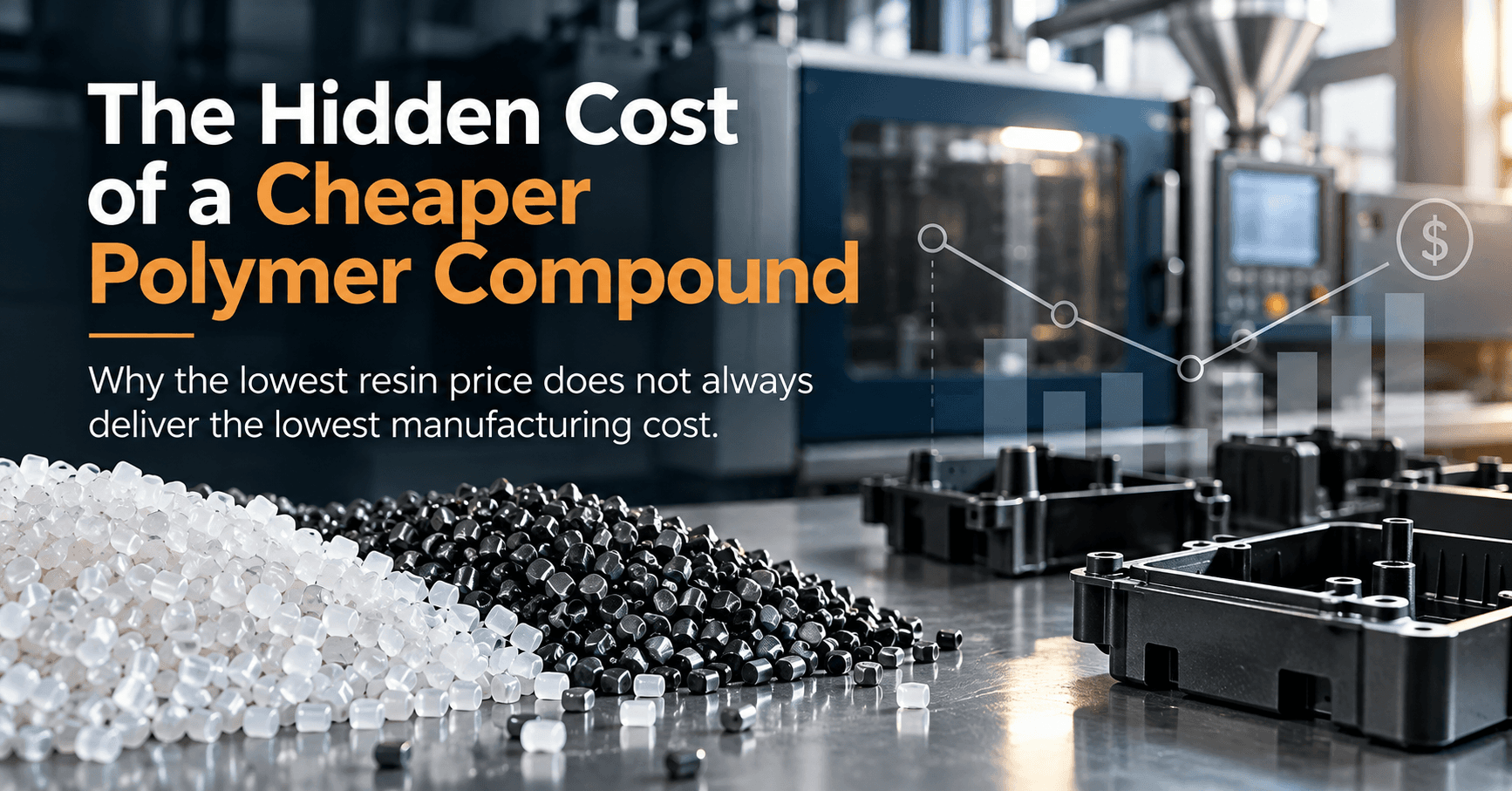
The Hidden Cost of a Cheaper Polymer Compound
Why the lowest price per kilogram does not always deliver the lowest manufacturing cost—and how plastics processors can evaluate material economics more effectively.
A polymer compound priced 10% below its alternative appears to offer a straightforward purchasing advantage. For a manufacturer consuming hundreds of tons of material annually, the potential savings can be substantial.
But the economics of polymer processing are rarely that simple.
Two compounds with comparable mechanical properties and similar technical data sheets may behave differently during production. One may require longer cooling times. Another may produce heavier parts because of its higher density. Differences in melt behavior, dimensional stability, or process consistency can influence scrap rates, machine utilization, and finished-part quality.
These effects are not always apparent in a material quotation.
The relevant question for a plastics manufacturer is therefore not simply which compound costs less per kilogram. It is which material produces an acceptable finished component at the lowest sustainable manufacturing cost.
That distinction becomes particularly important for small and midsized processors, where a few percentage points of additional scrap or a modest increase in cycle time can materially affect production economics.
The purchasing-price illusion
Polymer compounds are generally purchased by weight. Manufacturers receive quotations expressed in dollars per kilogram or pound, and purchasing departments naturally use these figures to compare suppliers.
This approach works reasonably well when two materials are genuinely interchangeable: equivalent density, processing behavior, quality consistency, and application performance.
However, a polymer compound is not simply a commodity defined by its base resin.
Its properties depend on several factors, including polymer grade, molecular characteristics, filler content, reinforcement, additives, and compounding quality.
Consider two polypropylene compounds intended for the same injection-molded component.
Both may satisfy the application’s minimum tensile-strength requirement. Both may fall within an acceptable melt-flow range. Both may appear suitable based on their published technical specifications.
Yet their actual manufacturing performance can differ.
A compound with a higher mineral-filler loading may offer a lower purchase price while increasing part weight. A formulation with different crystallization behavior may require adjustments to cooling or molding conditions. Differences in dimensional stability may affect the percentage of components meeting final tolerances.
These are possibilities to investigate, not inevitable consequences of choosing a lower-priced material.
Research from the National Institute of Standards and Technology (NIST) emphasizes that polymer processing outcomes depend on interactions among composition, flow, temperature, crystallization, and processing history. Material performance cannot always be predicted from composition or a limited set of properties alone.
The implication for manufacturers is important: a material’s economic value is determined by its behavior in the actual manufacturing process, not solely by its purchase specification.
Five costs that can disappear inside a material quotation
1. Density: When a cheaper kilogram produces fewer parts
Density is one of the most frequently overlooked variables in material-cost comparisons.
For a component with a fixed molded volume, a denser material generally produces a heavier part.
Consequently, a lower price per kilogram does not necessarily translate into a lower material cost per component.
Consider a simplified comparison.
Compound A
- Material price: $2.40/kg
- Density: 1.05 g/cm³
Compound B
- Material price: $2.20/kg
- Density: 1.20 g/cm³
Compound B is approximately 8.3% cheaper by weight.
Now consider a component with a molded volume of 50 cm³.
Using the relationship:
Part mass = Part volume × Material density
Compound A produces a theoretical part mass of 52.5 grams.
Compound B produces a theoretical part mass of 60 grams.
The resulting material costs are:
Compound A: 0.0525 kg × $2.40/kg = $0.126 per part.
Compound B: 0.0600 kg × $2.20/kg = $0.132 per part.
Despite its lower purchase price, Compound B costs approximately 4.8% more in material per finished component.
At an annual production volume of one million components, the difference amounts to $6,000 in material expenditure before considering processing losses.
This calculation assumes identical molded volume, no runner losses, and no material recovery. It also assumes that both materials satisfy the application’s requirements without dimensional redesign.
The principle is well established in polymer selection. Technical guidance from compound manufacturers including Avient and Teknor Apex discusses the importance of comparing material costs on a volume basis rather than relying exclusively on price per unit weight.
For processors evaluating filled polypropylene, thermoplastic elastomers, and other compounds with meaningfully different densities, this calculation should be an early screening step.
2. Cycle time: The cost of occupying a machine
Injection molding economics depend heavily on how many acceptable components a machine produces during a given period.
A material that requires longer processing cycles may increase conversion cost even when its purchase price is attractive.
Cycle time includes mold filling, packing, cooling, mold opening, part ejection, and other operations within the molding cycle.
Material selection can influence several of these stages.
Differences in melt viscosity, thermal behavior, crystallization, and dimensional stability may require changes to processing conditions. In some applications, these differences affect how quickly a component can be produced while maintaining acceptable quality.
The relationship between material properties and processing behavior is complex. A lower-viscosity compound, for example, does not automatically guarantee a shorter overall molding cycle. Cooling, packing, dimensional stability, and part geometry may dominate the process.
Consider a four-cavity injection mold operating at a fully loaded machine rate of $75 per hour.
At a 30-second cycle, the machine produces 120 molding cycles per hour, or 480 components before rejects.
At a 33-second cycle, output falls to approximately 436 components per hour.
The machine-time cost per component therefore increases from approximately $0.156 to $0.172.
That difference may appear modest. But at 500,000 components annually, it represents approximately $7,800 in additional allocated machine cost, assuming the same hourly rate and no change in other operating conditions.
This is not necessarily an equivalent increase in immediate cash expenditure. The financial impact depends on whether machine time represents avoidable operating cost, additional required capacity, or an opportunity cost associated with constrained production.
For a manufacturer operating near capacity, the commercial consequences may extend beyond the accounting cost of machine time.
A longer cycle can reduce available capacity for other production orders. It may increase scheduling pressure or contribute to overtime and delivery delays.
A lower-priced compound can therefore become more expensive if it consumes materially more manufacturing capacity.
The appropriate comparison is not the fastest cycle observed during a short trial. It is the repeatable production cycle achieved under controlled conditions while meeting all quality requirements.
3. Scrap and rework: The economics of imperfect production
Scrap is another important component of material economics.
Two compounds may produce similar parts under ideal conditions but differ in their consistency across extended production runs.
Potential problems include dimensional variation, warpage, incomplete filling, surface defects, contamination, and unacceptable mechanical performance.
These outcomes can arise from interactions among formulation, processing conditions, tooling, material handling, and equipment condition.
It would be incorrect to attribute every production defect to the compound itself.
However, when comparing alternative materials, manufacturers should establish whether a change in formulation affects the process window or the frequency of unacceptable components.
Consider a production operation with a 4% reject rate.
For every 1,000 components produced, approximately 960 are accepted.
If an alternative material increases the reject rate to 7%, only 930 components are accepted.
Producing the same number of acceptable components now requires more molding cycles, additional material, and greater machine occupancy.
The economic effect is broader than the value of discarded resin.
Rejected components may already contain substantial accumulated conversion cost. Depending on the process, they may also have undergone inspection, handling, assembly, or secondary operations.
Some rejected material can be recovered through controlled regrinding and reuse. However, recovery is not necessarily complete, and the permitted regrind fraction may depend on application requirements, material degradation, customer specifications, and quality controls.
The correct economic comparison should therefore distinguish between gross scrap, recoverable material, and permanently lost production value.
4. Process stability: The cost of a narrow operating window
A compound that performs well during a short qualification trial may not necessarily deliver equally stable performance during routine manufacturing.
This distinction is particularly relevant when production conditions vary.
Material drying, residence time, melt temperature, moisture exposure, and other processing variables can affect different polymers in different ways.
For example, moisture-sensitive engineering thermoplastics may require carefully controlled drying and handling. Improper moisture management can contribute to degradation and changes in properties.
Research published in Polymer Testing has documented difficulties in obtaining reliable melt-flow measurements for moisture-sensitive materials when degradation occurs under test conditions.
The broader lesson is that a single specification value cannot fully describe how a compound will behave under every processing condition.
For manufacturers, a useful qualification program should consider the robustness of the process—not simply whether acceptable components can be produced once.
Questions worth examining include:
- How consistently does the material fill the mold under normal production conditions?
- How sensitive are critical dimensions to reasonable processing variations?
- Does the material require additional drying, handling, or monitoring?
- How stable are appearance and mechanical performance across production lots?
- How frequently must operators adjust process settings to maintain acceptable output?
These questions help distinguish a material that is technically moldable from one that is commercially suitable for sustained production.
A compound with a wider usable processing window may justify a higher purchase price if it demonstrably reduces disruption, quality losses, or operator intervention.
That advantage must be measured rather than assumed.
5. Inventory and supply reliability: Costs beyond the production line
Material economics also extend into procurement and inventory management.
A compound may offer an attractive price but require a larger minimum order quantity, longer replenishment lead time, or less flexible delivery schedule.
These conditions can create additional working-capital requirements.
For example, a processor consuming 2,000 kilograms of a specialty compound each month may find a supplier’s 10,000-kilogram minimum order commercially inconvenient.
The purchase effectively represents five months of consumption.
Even when the material is competitively priced, the buyer must finance the inventory and manage the risks associated with storage, demand changes, specification revisions, and potential obsolescence.
Conversely, a material with a higher purchase price but smaller ordering increments may reduce inventory exposure.
The economics depend on the actual price differential, financing costs, ordering frequency, transportation expenses, and supply risk.
Lead-time variability can also have financial consequences.
A lower-priced compound may become unattractive if uncertain deliveries force a manufacturer to maintain excessive safety stock or interrupt production.
These costs are difficult to capture through a conventional price-per-kilogram comparison.
Nevertheless, they belong in the purchasing decision.
A worked example: When a lower-priced compound costs more
Consider a hypothetical manufacturer producing 500,000 injection-molded components annually.
The company is evaluating two compounds for the same application.
Compound A is the currently qualified material.
Compound B is an alternative offered at a lower purchase price.
Both are assumed to satisfy the required end-use specifications. The question is whether Compound B provides a genuine manufacturing-cost advantage.
The two materials
Compound A — Current material
Purchase price: $2.40/kg Part weight: 40 grams Production cycle: 30 seconds Reject rate: 4%
Compound B — Lower-priced alternative
Purchase price: $2.15/kg Part weight: 44 grams Production cycle: 33 seconds Reject rate: 7%
The operation uses a four-cavity mold with a fully loaded machine rate of $75 per hour.
For simplicity, the model assumes that all four cavities produce parts on every cycle, rejected components are identified after molding, and the stated part weights represent net purchased-material consumption per molded component. It excludes runners, regrind credits, startup losses, tooling changes, freight, and qualification expenses.
The values are illustrative assumptions—not measured performance data from commercial compounds.
Step 1: Compare material cost per molded component
Compound A:
0.040 kg × $2.40/kg = $0.096
Compound B:
0.044 kg × $2.15/kg = $0.0946
At this stage, Compound B appears slightly cheaper.
Its purchase price is approximately 10.4% lower, but its higher part weight reduces the actual material-cost advantage to approximately 1.5%.
Step 2: Include machine conversion cost
At a 30-second cycle, the four-cavity mold produces 480 components per hour before rejects.
Compound A therefore carries a machine-time cost of:
$75 ÷ 480 = $0.1563 per molded component
At a 33-second cycle, the machine produces approximately 436 components per hour.
Compound B carries a machine-time cost of:
$75 ÷ 436.36 = $0.1719 per molded component
Compound B’s longer cycle more than offsets its small material-cost advantage.
Step 3: Account for rejected components
The relevant output is not the number of components molded. It is the number of acceptable components produced.
A simple cost-per-good-part calculation is:
Cost per good part = (Material cost per molded part + Machine cost per molded part) ÷ Production yield
Production yield is the percentage of molded components accepted.
For Compound A:
($0.096 + $0.15625) ÷ 0.96
Cost per good part = $0.2628
For Compound B:
($0.0946 + $0.171875) ÷ 0.93
Cost per good part = $0.2865
Step 4: Calculate the annual impact
The difference is approximately $0.0238 per acceptable component.
Across 500,000 acceptable components annually, Compound B produces approximately $11,900 in additional modeled manufacturing cost.
This occurs despite its purchase price being more than 10% lower.
The example does not establish that lower-priced compounds generally have inferior processing performance. It demonstrates how relatively small differences in part mass, cycle time, and reject rate can reverse the apparent economics of a material substitution.
It also illustrates why material comparisons should be performed using actual production data wherever possible.
Importantly, the model is a recurring production-cost comparison. It does not include the one-time cost of qualifying Compound B, nor does it establish how much of the calculated machine-time difference would translate into cash savings or additional contribution margin.
Those questions require a separate business assessment.
Not every premium compound is worth the premium
The argument for evaluating total manufacturing cost should not be mistaken for an argument that higher-priced compounds are inherently superior.
They are not.
A more expensive formulation may offer properties that provide no meaningful benefit in a particular application.
A manufacturer might be paying for impact resistance, thermal stability, reinforcement, or other characteristics beyond what the component actually requires.
In other cases, a lower-priced compound may perform equivalently to the incumbent material while meeting all necessary specifications.
This is particularly relevant when the original material was selected under different commercial conditions or when the application has evolved.
The opportunity may involve identifying a suitable existing alternative rather than developing a new formulation.
The key is to distinguish between necessary performance and unnecessary specification.
A material substitution that reduces purchase cost without changing process stability, finished-part performance, or supply risk can produce a genuine economic benefit.
Equally, a modified formulation may justify additional cost if it improves processing economics or resolves a recurring manufacturing problem.
Neither conclusion should be reached without evidence.
A practical framework for evaluating alternative compounds
Manufacturers do not need an elaborate financial model to improve material-selection decisions.
A disciplined evaluation can begin with five questions.
First: Does the material satisfy the application?
Before comparing economics, establish the technical requirements that cannot be compromised.
These may include mechanical performance, dimensional tolerances, chemical resistance, thermal behavior, regulatory requirements, appearance, and long-term durability.
The evaluation should distinguish mandatory requirements from preferences or historical specifications.
A lower-cost material that fails a critical application requirement is not an economic alternative.
Second: What is the actual material consumption per acceptable component?
Compare molded-part weight, density, runner consumption, unrecovered scrap, and any permitted regrind recovery.
Use cost per acceptable component rather than price per kilogram as the principal material-cost measure.
Third: How does the compound affect production efficiency?
Measure repeatable cycle time, acceptable output, process adjustments, drying requirements, and other material-dependent conversion costs.
Where production capacity is constrained, consider the value of additional machine availability.
Fourth: What does the supplier relationship cost?
Evaluate minimum order quantities, replenishment lead times, delivery reliability, documentation, lot-to-lot consistency, and responsiveness to technical questions.
These factors may not appear in the purchase price, but they can affect working capital and operating risk.
Fifth: What will it cost to make the change?
A material substitution may require sampling, tooling adjustments, processing trials, dimensional inspection, mechanical testing, customer approval, or formal requalification.
For some applications, these costs are modest.
For others, particularly products with demanding performance or regulatory requirements, qualification may represent a substantial investment.
The expected recurring savings should be evaluated against the cost, risk, and time required to implement the change.
The break-even question
One useful way to evaluate a proposed material change is to calculate how much the alternative must save before switching becomes financially attractive.
Suppose a manufacturer expects an alternative compound to reduce total production cost by $0.015 per acceptable component.
At an annual volume of 500,000 components, the potential recurring benefit is $7,500 per year.
If qualification and implementation require a one-time investment of $12,000, the simple payback period is:
$12,000 ÷ $7,500 = 1.6 years
Whether that investment is attractive depends on the expected remaining production life, demand uncertainty, technical risk, and the company’s financial priorities.
The calculation should also account for any recurring costs introduced by the alternative, as well as the timing of savings and the possibility that qualification is unsuccessful.
This approach changes the discussion from a purchasing-price comparison into an investment decision.
What manufacturers should ask their compound suppliers
The quality of a material decision depends partly on the quality of information available.
Technical data sheets provide an essential starting point, but they rarely describe every factor relevant to production economics.
When evaluating an alternative compound, manufacturers should seek clarity on several issues.
Formulation and performance: Which characteristics distinguish the proposed compound from the incumbent material? Are differences in filler loading, density, reinforcement, or additive systems relevant to the application?
Processing requirements: What drying conditions, melt-temperature ranges, and other processing parameters are recommended? Are there known sensitivities that should be investigated during trials?
Consistency: What material properties are controlled during production, and what lot-specific documentation is available?
Qualification: What test data are available, and which application-specific tests remain the customer’s responsibility?
Commercial conditions: What are the minimum order quantities, typical lead times, and requirements for samples or trial quantities?
A capable supplier should be able to support a technically informed discussion about the material’s characteristics and intended processing conditions.
However, supplier recommendations cannot replace qualification under the manufacturer’s actual operating conditions.
From purchasing efficiency to manufacturing efficiency
For plastics manufacturers, material cost reduction remains an important competitive priority.
But purchasing efficiency and manufacturing efficiency are not always the same thing.
The lowest material quotation may produce the lowest total cost—or it may not.
Density can change consumption per part. Processing behavior can influence machine productivity. Scrap affects the number of acceptable components obtained from purchased material. Supply conditions influence inventory requirements and operational risk.
These variables interact.
A rigorous material-selection process therefore considers three distinct questions:
Is the material technically suitable?
Can it be processed consistently and efficiently?
Does it deliver the best overall economic outcome?
Only when all three questions have satisfactory answers can a manufacturer make a well-supported purchasing decision.
The objective is not to buy the cheapest polymer compound.
It is to manufacture acceptable products at the lowest sustainable cost, with an appropriate level of technical and supply-chain risk.
That is a more demanding standard—but also a more useful one.
Exploring an alternative polymer compound?
LaunchBridge Materials works with manufacturers evaluating polymer compounds and masterbatches for existing applications, alternate sourcing, and application-specific requirements.
If you are reviewing material costs, qualification requirements, or formulation options, contact LaunchBridge Materials to discuss your application and sourcing needs.