
Insight
Minimum Order Quantities: The Real Economics of Buying Polymer Compounds
Compare polymer compound MOQs through production economics, inventory costs, cash exposure, and demand risk\u2014and identify order structures that fit actual consumption.

A compound quote offers an attractive price, but only if the processor buys enough material to cover the next twelve months. The immediate requirement covers two months. Procurement sees a discount. Operations sees additional stock. Finance sees cash leaving well before the material becomes saleable product.
All three views are valid. The decision depends on whether the savings from a larger order exceed the cost and risk of holding it, and whether the business can fund the commitment.
For polymer compounds, the most useful starting question is: what does this minimum actually apply to? A manufacturing batch, a purchase commitment, and a delivery quantity can be different numbers.
An MOQ can describe several different constraints
A production minimum is the quantity a manufacturer requires to run a grade or formulation. A purchase minimum is the quantity the buyer must commit to. A release minimum is the smallest shipment permitted under an agreed order. A packaging increment determines how quantities can be rounded into bags, cartons, or other containers.
A quotation may combine these constraints, but they should be stated separately. A manufacturer might require a complete production campaign while agreeing to multiple deliveries. Alternatively, a supplier might ship a small quantity from an existing batch without offering that quantity for a new custom production run.
Packaging size alone does not establish the commercial minimum. For example, Ensinger describes 25 kg bags alongside bulk packaging for its compounds, including trial and prototype use. That statement is not a universal 25 kg MOQ, nor a commitment to manufacture every custom grade in that quantity.
Ask whether the quoted minimum applies per grade, color, manufacturing lot, purchase order, or shipment. An annual forecast spanning several colors may not satisfy the minimum for any individual formulation.
Why a compounder wants a longer run
Compound manufacture involves more than putting ingredients through an extruder. Coperion describes the process as a sequence that includes feeding, melting, dispersing, homogenizing, devolatilizing, filtering, and pelletizing. Different recipes place different demands on that sequence.
Changing a recipe can require preparation, equipment cleaning, adjustments, and confirmation that the resulting material meets the agreed specification. Some of this effort occurs whether the saleable run is short or long. Raw-material purchase increments and recipe-specific ingredients can add a separate constraint; ask the manufacturer whether either is driving the quote.
Cleaning is particularly relevant to color and contamination control. In its masterbatch equipment literature, Coperion explicitly connects faster cleaning with economical recipe and color changes. This supports the connection between changeover effort and campaign economics. It does not establish a standard batch minimum for the industry.
The arithmetic is straightforward: fixed campaign cost divided by saleable kilograms becomes smaller as the run grows. Illustrative example: allocating $1,000 of setup and release effort over 500 kg adds $2.00/kg; allocating it over 5,000 kg adds $0.20/kg. These assumed numbers are not estimates of actual compounder costs.
A small-batch surcharge can therefore be commercially rational. Whether it is economical for the buyer requires a separate calculation. The minimum that works best for the manufacturer need not be the quantity that works best for the processor.
Translate kilograms into a consumption horizon
An MOQ has little meaning without a credible consumption rate. Divide the proposed receipt quantity by expected monthly use of that exact grade and color. A 3,000 kg receipt consumed at 250 kg/month represents twelve months of supply. At 1,000 kg/month, the same receipt represents three months.
Use actual compound consumption rather than finished-part weight alone. Allow for startup losses, rejected parts, runners where relevant, and the approved use of regrind. Avoid counting recoverable material twice. For a new program, distinguish firm customer orders from the forecast that assumes a successful launch.
Keep cycle stock and safety stock separate. A larger purchase creates more stock between receipts; it does not automatically create the right protection against uncertain lead times or demand. If the supplier's next production slot is unreliable, a smaller order may require additional safety stock or a different replenishment agreement.
There is no universal acceptable number of months. A stable repeat product can justify a different commitment from an unqualified custom color or a component approaching a design revision.
Compare total annual cost, then test cash exposure
Inventory analysis balances replenishment costs against holding costs. MIT's inventory and EOQ teaching materials examine these relationships, including quantity discounts. For a processor comparing discrete supplier offers, calculating each feasible option is often more useful than seeking one theoretical optimum.
For stable, repeated demand, a simple screening calculation is:
Annual relevant cost = annual material purchases + annual replenishment costs + annual inventory carrying costs.
With receipts arriving all at once and consumption declining evenly to zero before the next receipt, average cycle inventory is half the order quantity. Multiply that quantity by the material price and the annual carrying rate to estimate its carrying cost.
The carrying rate should reflect the costs relevant to the decision, including financing or the opportunity cost of cash, storage, and applicable insurance or handling. Use the business's own figures. Do not count a cost both inside that rate and as a separate charge. Demand-driven write-offs are excluded from the example below and tested separately.
A lower price with a narrow economic advantage
Consider a hypothetical processor consuming 3,000 kg/year, evenly at 250 kg/month. Both offers cover an already-qualified equivalent compound and provide reliable replenishment. Assume no safety stock, no shortages, unchanged processing yield, and no terminal inventory loss. Prices are delivered; the additional $150 per receipt covers incremental ordering, receiving, and inspection effort, not freight already included in the price. Carrying cost is an assumed 20% per year on material value.
Smaller-order option: receive 500 kg at $4.20/kg, six times annually. Material purchases total $12,600. Replenishment costs total $900. Average cycle inventory is 250 kg, worth $1,050, generating $210 in carrying cost. Annual relevant cost is $13,710, or $4.57 per kilogram consumed.
Larger-order option: receive 3,000 kg at $4.00/kg, once annually. Material purchases total $12,000. Replenishment cost is $150. Average cycle inventory is 1,500 kg, worth $6,000, generating $1,200 in carrying cost. Annual relevant cost is $13,350, or $4.45 per kilogram consumed.
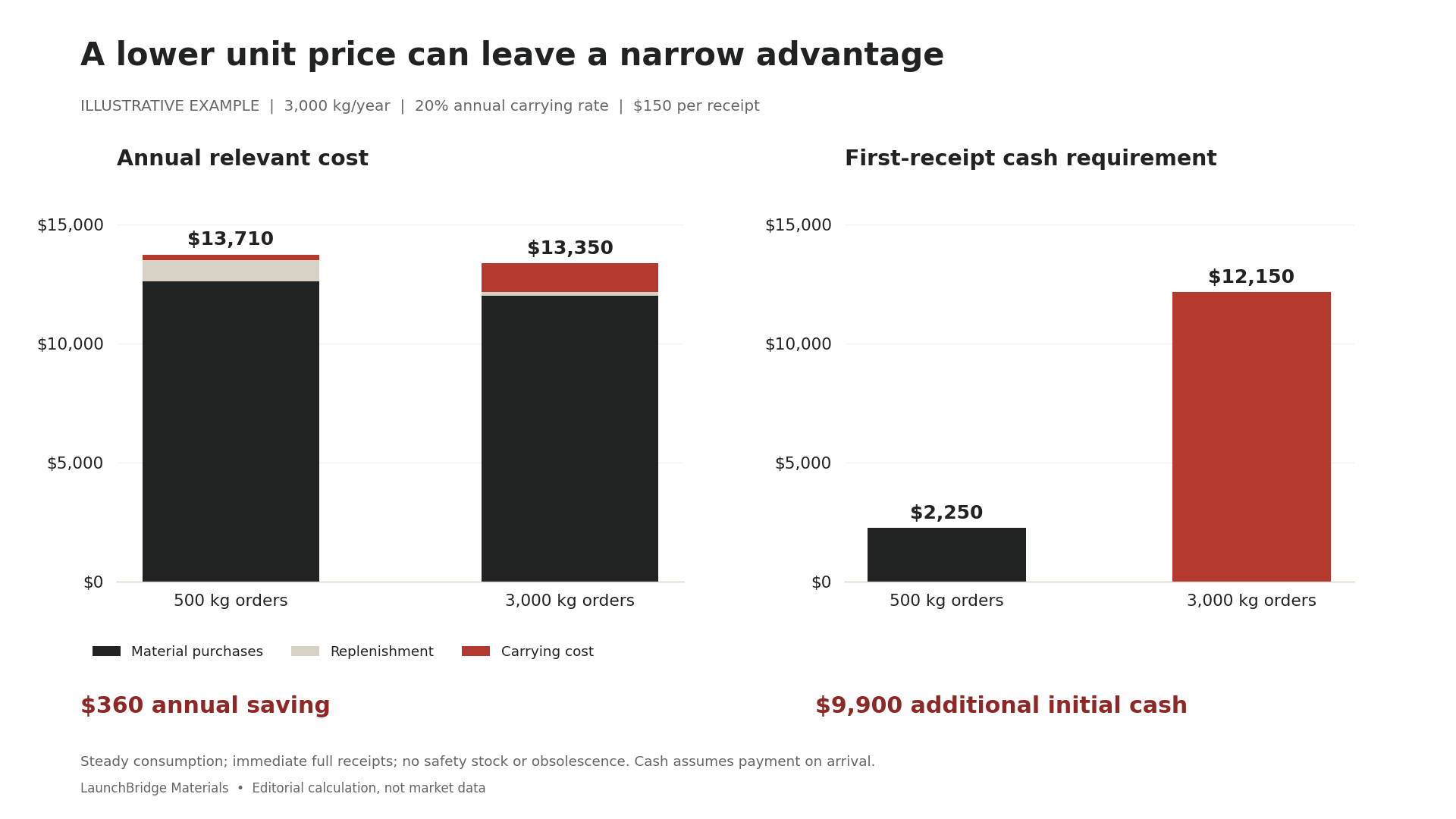
The larger order saves $600 on material and $750 on replenishment effort, but adds $990 in carrying cost. Its net annual advantage is $360. Under these assumptions, it is the less expensive option.
The cash requirement is a different comparison. If material and receipt costs are paid on arrival, the first smaller receipt requires $2,250; the larger receipt requires $12,150. The $9,900 difference is additional initial cash exposure, not an extra annual expense to add to the calculation. The carrying charge already represents the assumed cost of holding inventory.
Payment terms may change the timing materially. Compare the actual payment and consumption schedule before deciding that an annually cheaper option is affordable.
Find the assumption that changes the answer
In this example, the larger order's annual purchase and replenishment advantage is $1,350. Its additional average inventory value is $4,950. At an annual carrying rate of approximately 27.3%, the added carrying cost consumes the entire advantage. Above that rate, the smaller option is cheaper under the other unchanged assumptions.
Demand risk can also erase a narrow saving. If a separate, consistently estimated annual expected obsolescence loss is $500 greater for the larger option, its $360 advantage becomes a $140 disadvantage. The $500 is an illustration, not a predicted loss rate. Do not add it separately if obsolescence is already included in the carrying rate.
For a launch or finite program, replace the repeating-cycle model with a dated cash-and-inventory schedule. Track purchases, consumption, ending usable stock, and any credible recovery value. An order exceeding the program's remaining requirement cannot be evaluated as though all kilograms will eventually be consumed.
Inventory can become unusable before the polymer deteriorates
Custom color, a customer-specific approval, or a narrowly defined formulation can restrict where surplus material may be used. A design change or program cancellation can strand otherwise serviceable inventory. For that reason, commercial obsolescence and physical storage stability belong in separate discussions.
Longer storage also requires a credible handling plan. Celanese's Polyester Technical Manual, for example, advises protection against packaging damage, contamination, and temperature and humidity extremes, and specifies drying to recommended moisture levels before processing its polyester materials. These are material-specific instructions, not a shelf-life rule for every compound.
Obtain the selected grade's current storage and drying guidance, any stated shelf-life or retest requirements, and the condition of the delivered packaging. Do not assume that an arbitrary twelve-month horizon makes all compounds unacceptable, or that sealed packaging makes every grade indefinitely suitable.
Negotiate the constraint that creates the cost
Once the minimum is understood, alternatives become easier to discuss. Their availability depends on the supplier, grade, and commercial agreement.
Pay explicitly for a smaller campaign
Request a price for the required quantity with a stated setup or small-lot charge. Compare that complete offer against the larger batch, including replenishment frequency and inventory exposure. A higher price per kilogram can be worthwhile when it avoids a much larger commitment to uncertain demand.
Separate production from deliveries
A blanket order with scheduled releases may let the manufacturer run a larger campaign while the processor receives smaller quantities. Clarify when payment is due and who owns the remaining stock. If the buyer prepays the whole campaign, smaller physical deliveries may reduce on-site storage without reducing the cash commitment.
Specify the final release date, cancellation treatment, price adjustments, storage charges, quality responsibilities, and liability for unused material. Supplier-held inventory is not automatically supplier-financed inventory.
Explore a shared grade before a unique formulation
An existing qualified grade or color may be easier to replenish than a formulation used by one customer. Consolidating demand across parts can help only where the technical specification and approvals allow it. A similar polymer designation is insufficient evidence of interchangeability.
Moving from a precolored compound to a natural compound plus masterbatch is another possible route, but it changes the processing and qualification question. Confirm dosing capability, carrier compatibility, dispersion, appearance, and applicable performance requirements before assigning any purchasing benefit.
Separate trial supply from recurring supply
Ask for three quantities and three lead times: initial evaluation material, a representative production trial, and routine replenishment. RTP Company describes samples for pre-production trials after compound properties are approved; this illustrates a development stage, not a promise that trial quantities establish the recurring production MOQ.
A distributor may offer smaller releases from stock it chooses to hold, or coordinate demand where technically and commercially appropriate. Ask what is actually available for the specific grade, who finances the inventory, and what happens when stock runs out. This is a possible supply arrangement, not a claim that LaunchBridge stocks or guarantees any particular material.
Make the next quote comparable
Give suppliers enough information to distinguish immediate need from future opportunity:
- The exact grade or application specification, color, required documentation, and approval status.
- Material needed for evaluation, the first production run, and repeat orders.
- Monthly consumption, seasonal peaks, firm demand, and the confidence behind the forecast.
- Requested production minimum, purchase commitment, release quantity, and packaging increment stated separately.
- Delivered prices at each quantity, any campaign charge, payment terms, and release deadlines.
- Lead time for stocked supply and for a new campaign, plus the terms for residual inventory.
Then compare the feasible offers against the same demand and quality assumptions. Test what happens if consumption is slower, a release is delayed, or the program changes. Include credible shortage and qualification costs where the options differ; the lowest inventory commitment is not automatically the most reliable supply arrangement.
Choose the order structure that earns its inventory exposure. A larger MOQ can be economical for stable consumption with meaningful replenishment savings. A smaller batch can be worth its premium when it preserves cash and limits an uncertain commitment. The useful decision is the one that connects the supplier's campaign economics to the processor's actual consumption, rather than stopping at the quoted price per kilogram.