
Material Guide
Glass-Filled vs. Mineral-Filled Polymers: Choosing Reinforcement for Performance and Cost
Compare glass-fiber and mineral-filled polymer compounds through stiffness, warpage, appearance, processing and total cost per good part.
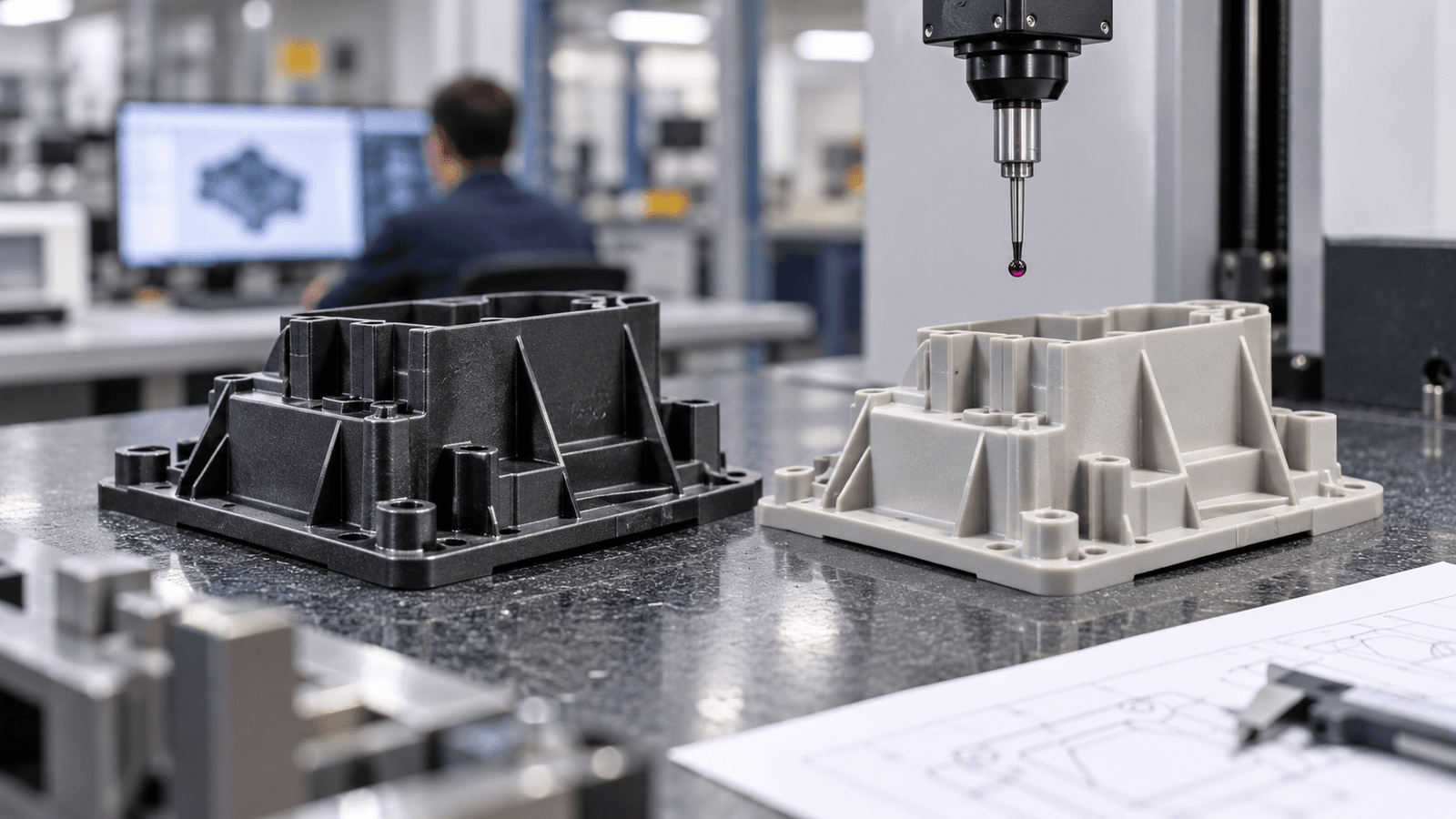
Glass-filled and mineral-filled compounds can both make a polymer stiffer. They rarely produce the same part, however. Glass fibers preferentially reinforce along their orientation; mineral particles and platelets often produce a more balanced dimensional response. That distinction affects mold design, warpage, surface quality, impact performance and the true cost of a finished component.
Start with the part, not the filler percentage
A procurement comparison that begins with “30% filled polypropylene” leaves out the most important information: what the part must do. A thin structural bracket with a defined load path may benefit from glass-fiber reinforcement. A broad, visible injection-molded cover may benefit more from a mineral-filled formulation that controls shrinkage and appearance. Neither conclusion follows from filler content alone.
Glass and mineral loading are normally specified by weight, not volume. Since glass, talc and calcium carbonate have different densities, equal weight percentages do not imply equal reinforcement volume, geometry or cost per molded part. Base resin, filler grade, coupling chemistry, processing history and additives also change the result.
What each filler contributes
Glass fibers: directional reinforcement
Short glass fibers have a high aspect ratio. When they are adequately bonded to the polymer matrix, they can increase tensile and flexural stiffness and often improve strength and creep resistance. The actual gain depends on fiber length retained after compounding and molding, fiber orientation, resin-fiber adhesion and service temperature. Glass fibers generally reduce molding shrinkage along the primary fiber direction more than across it. The resulting anisotropy can be valuable in a designed load path but troublesome in a broad or geometrically complex part.
Higher glass loading can also bring more abrasive wear on processing equipment, visible fiber-related surface defects, greater sensitivity to gate and weld-line placement, and reduced elongation at break. Impact behavior is formulation- and test-dependent: “glass-filled” should never be treated as synonymous with “tougher.”
Mineral fillers: geometry and dimensional control
“Mineral-filled” is not a single material class. Talc is typically platelet-shaped; calcium carbonate is commonly particulate; mica has a plate-like morphology. Their reinforcement, shrinkage and appearance effects differ. Talc can increase stiffness and heat-deflection performance in suitable polypropylene formulations, while calcium carbonate may be used for dimensional, processing and economic objectives. Mica can contribute stiffness and dimensional control where platelet geometry is useful. Particle size, distribution, surface treatment and loading matter as much as the mineral name.
Mineral-filled compounds can offer more uniform shrinkage than strongly oriented glass-fiber systems, but low warpage is not guaranteed. Platelet orientation, wall-thickness changes, gate location, cooling and residual stress can still create distortion. Mineral additions also typically increase density and can reduce ductility or impact resistance unless the overall formulation compensates.
Comparison at the component level
| Decision factor | Short-glass-fiber-filled compound | Mineral-filled compound |
|---|---|---|
| Stiffness and structural load | Often attractive where reinforcement can align with principal loads | Can increase stiffness, but generally less efficient for high structural loads at comparable loading |
| Directionality | Pronounced fiber-orientation effects are common | Often more balanced, but platelets may also orient |
| Warpage and shrinkage | Lower shrinkage in fiber direction; differential shrinkage can drive warpage | Often selected for dimensional control; formulation and mold design remain decisive |
| Surface finish | Fiber read-through or exposed fibers can challenge appearance | Some mineral systems support smoother visible surfaces; grade-dependent |
| Impact and ductility | May reduce elongation; impact response varies widely | May reduce ductility; toughened grades can behave differently |
| Density | Increases with filler loading | Often increases substantially, depending on mineral and loading |
| Tooling/process | Abrasion, orientation and weld lines deserve attention | Dispersion, plate-out, abrasion and cooling still require validation |
| Economics | Evaluate structural efficiency and potential wall-thickness reduction | Evaluate compound price, part mass, cycle, scrap and dimensional yield |
This table describes typical tendencies, not grade-level performance guarantees. Compare actual supplier datasheets at matching conditioning, temperature, test direction and test method.
Why cost per kilogram is the wrong final metric
Suppose a glass-filled candidate costs $2.80/kg and produces a 0.180 kg part, while a mineral-filled candidate costs $2.20/kg and produces a 0.205 kg part. The illustrative material costs are:
- Glass-filled: 0.180 × $2.80 = $0.504 per part.
- Mineral-filled: 0.205 × $2.20 = $0.451 per part.
The mineral-filled part saves about 5.3 cents in material before runner losses, scrap, cycle time and processing costs. But if the glass-filled formulation enables a thinner wall without compromising stiffness, or if one candidate has materially lower warpage-related rejection, the comparison changes. These prices and weights are hypothetical and do not represent market quotations or specific grades.
A more useful purchasing model is total good-part cost: compound consumed per good part, including runners and scrap, plus molding time, finishing, quality losses, tooling wear and logistics. Account for part density and any redesigned geometry rather than assuming identical shot weights.
Four technical checks that prevent expensive substitutions
1. Compare properties under relevant conditions
Review tensile and flexural modulus, strength, impact results, creep and heat performance. For hygroscopic polymers such as polyamides, compare dry-as-molded and conditioned data where available. Do not compare a dry PA66 glass-filled datasheet directly against a conditioned PA6 mineral-filled datasheet as though the results were equivalent.
2. Test orientation-sensitive behavior
For fiber-filled grades, assess gate position, flow length, weld lines and loading direction. Tensile bars molded under standard conditions do not capture every local orientation in a production part. Use molded-part testing and dimensional measurement, especially near weld lines, bosses, ribs and long flow paths.
3. Check surface and tooling implications
Confirm whether visible surfaces permit fiber read-through, gloss variation or texture differences. Review abrasion and screw/barrel/tooling considerations with the processor. For mineral systems, ask about dispersion, deposits and any plate-out observed in the intended process.
4. Qualify the complete formulation
A “30% glass” or “20% talc” designation does not define an interchangeable grade. The resin molecular-weight range, filler morphology, sizing/coupling treatment, stabilizers, color package and processing characteristics may differ. Treat source changes as qualification events proportionate to part criticality.
A practical selection sequence
- Define the failure mode: deflection, strength, creep, heat distortion, warpage, surface finish, or total cost.
- Set measurable limits: service temperature, load duration, dimensional tolerances, visual criteria, impact and regulatory requirements where relevant.
- Shortlist within the same resin family first: isolate reinforcement effects before considering a base-polymer change.
- Request comparable evidence: actual grade datasheets, density, shrinkage by direction, relevant test conditioning and processing guidance.
- Trial in production-representative tooling: capture cycle, dimensional variation, scrap, appearance and critical mechanical performance.
- Calculate good-part economics: compare material mass, process time, quality yield and supply terms, not just quoted price per kilogram.
Where hybrid reinforcement fits
Some compounds combine glass fibers with mineral fillers to balance structural stiffness, shrinkage anisotropy, appearance and economics. Hybrids are not automatically a compromise that outperforms either individual filler: the benefit depends on loading ratio, morphology, dispersion and the part's flow pattern. They deserve consideration when pure glass reinforcement creates unacceptable distortion but an all-mineral formulation cannot meet the structural requirement.
The sourcing decision
The strongest reinforcement is not always the best commercial choice. Glass-filled compounds frequently earn their place where directional structural performance is the binding requirement. Mineral-filled compounds may be better suited to dimensional control, appearance and selected cost targets. The defensible decision is made at the finished part, under realistic processing and service conditions, using supplier-specific evidence. For manufacturers evaluating alternative formulations or sources, LaunchBridge Materials can help explore relevant compound options and supplier discussions; final material approval remains an application-specific engineering and qualification decision.
Technical references
- ISO 527 series, Plastics — Determination of tensile properties (test-method reference).
- ISO 178, Plastics — Determination of flexural properties (test-method reference).
- ISO 294-4, Plastics — Injection moulding of test specimens of thermoplastic materials — Determination of moulding shrinkage.
- ISO 75 series, Plastics — Determination of temperature of deflection under load.
- ASTM D638, Standard Test Method for Tensile Properties of Plastics.
- ASTM D790, Standard Test Methods for Flexural Properties of Unreinforced and Reinforced Plastics and Electrical Insulating Materials.
These standards identify relevant measurement methods, not performance values. Verify current editions and applicability with the test laboratory or supplier.