
Material Guide
Beyond the Datasheet: How to Evaluate Polymer Compounds for Real-World Applications
Datasheet properties are useful screening tools, but real-world material decisions require part-level evidence, processing trials, lifecycle performance, and supply evaluation.

The datasheet is a starting point, not a qualification decision
A material datasheet is designed to summarize selected properties under specified test conditions. A finished component, however, experiences a combination of geometry, processing history, loading, environment, and time. A compound that looks attractive in a property comparison can perform poorly when molded into a thin-walled housing, exposed to a cleaning chemical, or loaded continuously at elevated temperature. The practical question is not “Which grade has the highest number?” but “What evidence shows that this grade will work in this part, in this process, over its intended life?”
Understand what the reported number actually measures
A tensile modulus from a standardized specimen is useful for screening stiffness, but it is not a direct prediction of deflection in a ribbed part. Notched impact values describe behavior under a particular specimen geometry, notch, temperature, and test method; they are not universal drop-test results. Heat-deflection temperature depends on the test load and procedure and should not be treated as a maximum continuous-use temperature. Compare properties only when test methods, specimen preparation, conditioning, units, and measurement conditions are genuinely comparable. Missing values should be treated as unknowns, not as proof of poor or superior performance.
Translate service conditions into failure modes
Begin with the component's operating envelope: peak and sustained temperature, mechanical load, impact events, humidity, chemicals, UV exposure, electrical demands, dimensional tolerances, and expected life. Then identify plausible failure modes. A snap fit may fail from repeated strain or environmental stress cracking; a loaded bracket may deform by creep; an outdoor enclosure may embrittle after weathering; a precision connector may drift dimensionally as moisture content changes. A property is decision-relevant only if it helps assess a plausible failure mode.
Separate short-term properties from time-dependent behavior
Many datasheet properties are measured over seconds or minutes. Products often operate for years. Creep, stress relaxation, fatigue, oxidation, hydrolysis, and chemical exposure can change performance over time. Where those mechanisms matter, seek grade-specific long-term data or conduct application-representative testing. For glass-filled grades, remember that fiber orientation, weld lines, and processing conditions can make molded-part behavior direction-dependent. A single tensile-strength figure does not capture that complexity.
Treat processing as part of material performance
Material selection and process selection cannot be separated. Melt viscosity and flow behavior affect filling pressure, weld-line formation, and thin-wall feasibility. Drying requirements and moisture sensitivity influence both process consistency and final properties. Mold temperature, residence time, shear, and cooling history affect crystallinity, dimensions, appearance, and mechanical response. Before qualifying an alternative compound, establish a feasible processing window on production-representative equipment and tooling, and document which adjustments were necessary.
Compare candidates with an evidence matrix
An effective comparison uses a short list of must-pass requirements, then ranks the remaining trade-offs. Do not average away a safety-critical failure with a strong score on price or stiffness. The table below provides a practical starting point for cross-functional review.
| Decision Area | Datasheet Screening | Application Evidence |
|---|---|---|
| Mechanical | Modulus, strength, impact method and conditions | Part-level loading, weld lines, fatigue/creep |
| Thermal / Environmental | HDT, conditioning, chemical-resistance guidance | Combined heat, humidity, chemicals, aging |
| Processing | Flow, drying, recommended temperatures | Production tooling trial, stability, scrap |
| Commercial | Quoted price/kg, MOQ, lead time | Cost/good part, supply continuity, change control |
Decision areaDatasheet screeningApplication evidenceMechanicalModulus, strength, impact method and conditionsPart-level loading, weld lines, fatigue/creepThermal/environmentalHDT, conditioning, chemical-resistance guidanceCombined heat, humidity, chemicals, agingProcessingFlow, drying, recommended temperaturesProduction tooling trial, stability, scrapCommercialQuoted price/kg, MOQ, lead timeCost/good part, supply continuity, change control
A lower resin price may not mean a lower part cost
Consider two hypothetical compounds for the same molded component. Grade A costs $3.20/kg and uses 0.120 kg per good part; Grade B costs $2.90/kg but uses 0.125 kg because of a design or density difference. Material cost is $0.384 versus $0.3625 per part. The apparent saving is $0.0215 per part before scrap, cycle time, drying, freight, qualification, and inventory costs. If Grade B raises scrap by two percentage points, that change may erase part of the saving. These figures are illustrative, not market price benchmarks; actual comparisons should use validated yields and complete conversion economics.
Qualify the material, process, and supply arrangement together
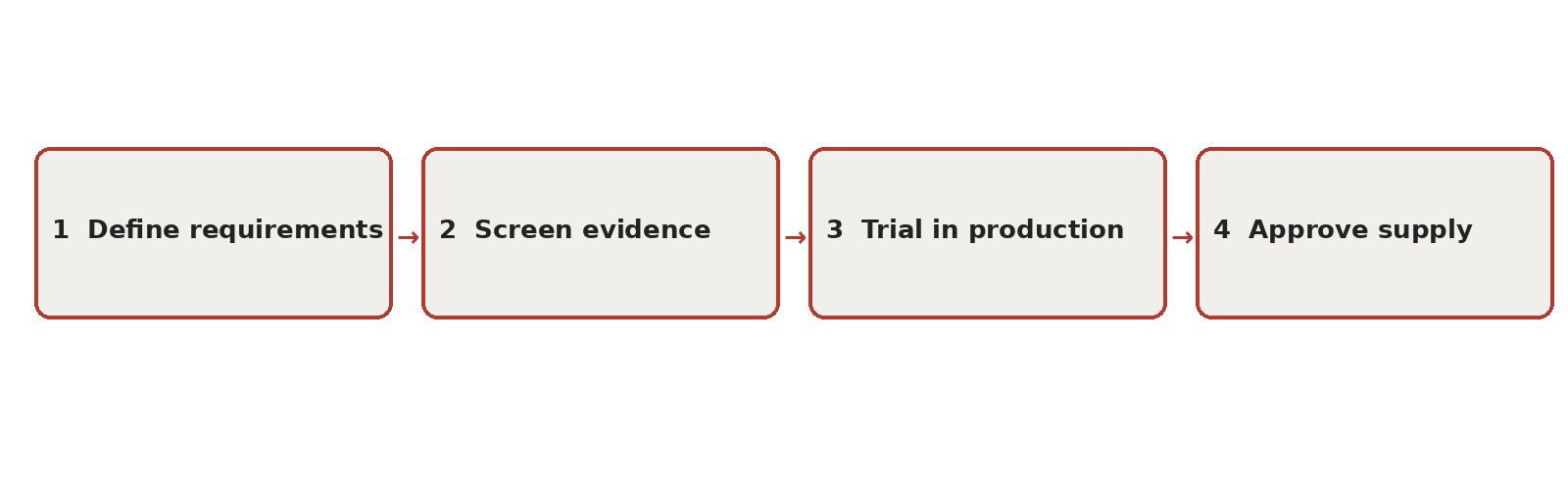
A staged qualification reduces avoidable disruption. First, screen the grade against mandatory requirements and confirm comparable test evidence. Next, mold or extrude representative samples, measure critical characteristics, and test under relevant environmental and loading conditions. Then run a controlled production trial that includes dimensional capability, appearance, throughput, scrap, and process stability. Finally, review change control, traceability, batch consistency, documentation, availability, lead time, and minimum order quantity. For regulated or safety-critical applications, follow the applicable approval and certification procedures rather than substituting an informal trial.
Questions that improve a supplier conversation
Ask for the exact grade designation and revision of its technical data, the test methods and conditioning behind critical values, available long-term or application-specific evidence, recommended processing conditions, and relevant chemical or environmental resistance information. Ask what formulation or manufacturing changes trigger notification, what consistency controls apply, and which documentation can accompany shipments. For an alternate source, request samples and an agreed qualification plan before assuming equivalence. The strongest supplier discussion begins with the part's requirements and constraints, not a request for a “matching datasheet.”
The decision standard
The datasheet earns a material a place on the shortlist. Qualification earns it a place in production. The best selection is not necessarily the grade with the strongest headline properties; it is the one with adequate performance margin, a repeatable processing window, acceptable total part economics, and a supply arrangement that supports the manufacturing operation.